My mother still tells the story. I was barely a year old, standing in the middle of a paddock on my father's farm in Bauru, surrounded by horses that towered over me. She says I was not frightened. She says neither were they. I cannot remember that moment, of course, but I believe it — because every encounter I have had with horses since has confirmed what my body understood before my mind could form words: that the space between a human and a horse, when both are still and present, is the most honest space in the world. Over the Dunes is the collection where I finally learned to honour that honesty on its own terms — not in my studio, not under my lights, but in the landscape where the horse and the earth have been in conversation for millennia, with no need for us at all.
My grandfather bred racehorses for the Jockey Club of São Paulo. My father continued that legacy as a veterinarian, teaching me to see horses not as beautiful objects but as sentient beings whose grace was structural — the visible expression of thousands of years of evolution toward something purposeful. Photography arrived by accident, through a group of friends studying in New York when I was nineteen. Within months, I understood that the camera could do what I had always wanted to do — hold a moment of connection between species and make it permanent, make it visible to people who had never stood in a stable at dawn and felt a horse lower its head toward them in trust.
That simple gesture — the lowered head, the soft eye, the breath that slows when fear is absent — became the foundation of everything I have built since. But it took me twenty years and fifty breeds across four continents before I was ready to make the work you see in Over the Dunes. It was the collection that changed everything.
The Arabian Peninsula Changed Everything
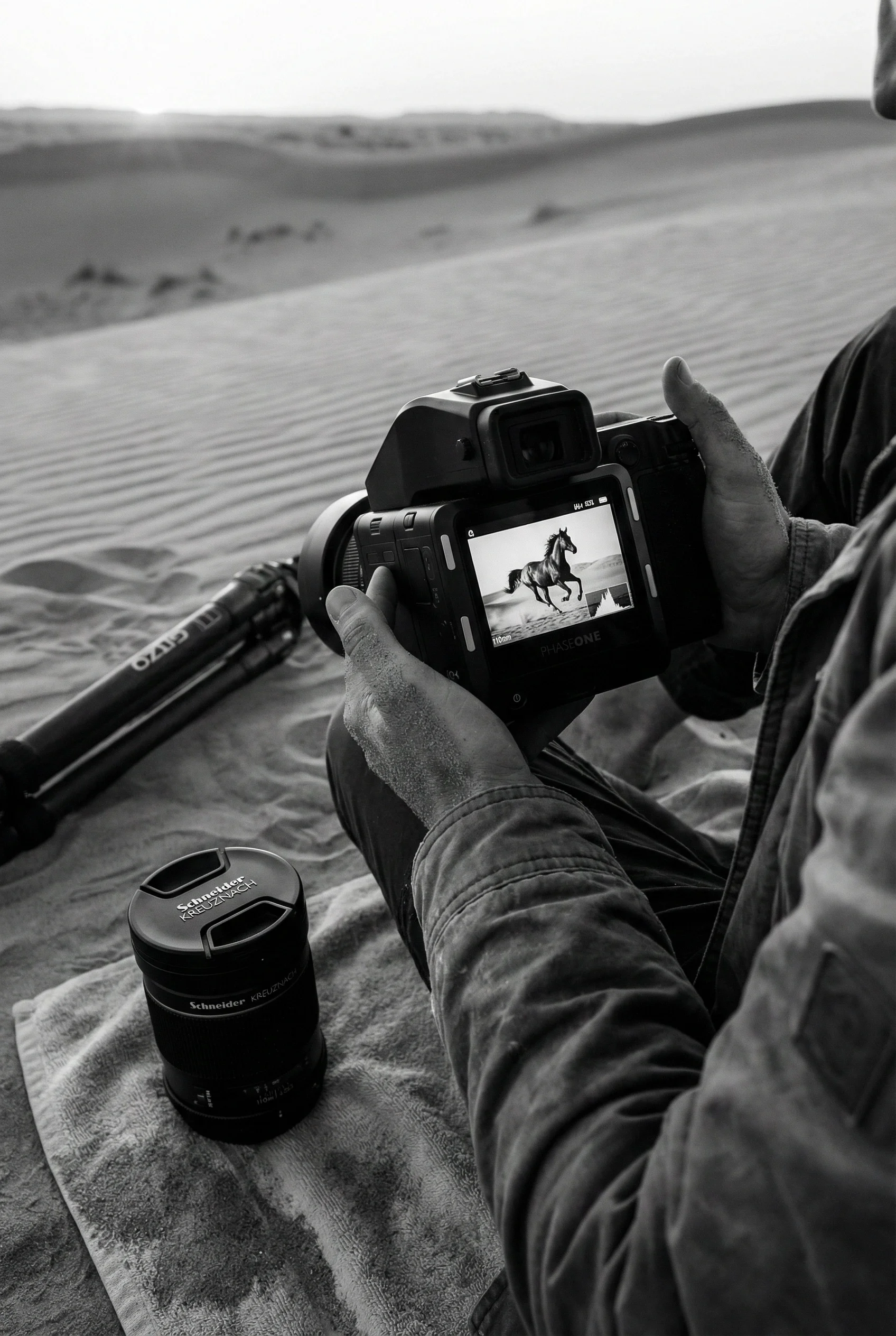
I had come for the horses. I had been photographing equine breeds globally for years — the chiaroscuro intimacy of studio portraits, the explosive power of racing series, the coastal light of shoreline work — and the Arabian horse, with its proud carriage and ancient bloodlines, was a subject I needed to understand. Centuries of desert breeding had sculpted these animals into creatures of impossible refinement: the dished profile, the high tail carriage, the compact elegance of a body designed to carry a Bedouin rider across vast distances on minimal water. I arrived in Dubai and Saudi Arabia with my Phase One IQ4 system, a set of Schneider Kreuznach lenses, and a clear plan to photograph them as I had photographed every breed before.
The desert dismantled that plan within days.
What I found was not merely a location. It was a revelation. The silence of it. The scale. The way a single dune ridge at dawn held more drama, more sculptural authority, more emotional weight than any studio I had ever built. I watched the light move across those dunes — the way it carved shadow from sand, the way a ridgeline at sunrise became as sharp and defined as a blade, the way the whole landscape seemed to breathe — and I understood that I had been doing something backwards. For my entire career, I had been bringing the horse into my world. The desert told me, in no uncertain terms, to follow the horse into its world.
I put down my artificial lights. I stopped composing. I let the wind and the emptiness do what they had been doing long before any camera existed.
In the desert, there are no distractions — only the truth of movement, the sculpture of wind, and the eternal dialogue between earth and spirit.
Interaction Without Interference
There is a moment in the making of every photograph in this collection that has nothing to do with the camera. It happens hours before the shutter opens — sometimes a full day before. I arrive at the location, set down my equipment, and simply stand. No lens is raised. No composition is framed. I watch. I breathe at the pace of the landscape. I wait for the horses to register my presence, to evaluate me with the ancient vigilance of prey animals who have survived forty million years by knowing precisely who belongs in their space and who does not.
Only when the tension dissolves — when the ears soften, when the heads lower, when the distance between man and animal ceases to be a boundary and becomes a conversation — does the work begin.
I call my approach interaction without interference. Horses are prey animals — sensitive, watchful, ancient in their instincts. They do not pose. They do not perform on command. But when they feel your energy is truthful, when you have given them a day or sometimes several days of simply being present, they offer you something no direction could produce: themselves. The best photographs are not taken. They are given.
In over two decades of working in close physical proximity to horses of every temperament, I have never experienced a single accident. I say this not as a boast but as a testament to the principle itself. Respect is its own protection. The horses in Over the Dunes were not directed, not manipulated, not startled into dramatic poses. They were allowed to be themselves, in their own time, in their own space. What appears in the final image is not a performance coerced by the photographer but a gift offered by the subject — a moment of natural grace that could not have been scripted because it was not scripted, that carries the authority of the authentic because it is authentic.

Why Monochrome: The Truth Beneath the Beauty
The question I am asked most often about this collection is why I chose to work in black and white. The answer is simple, though its implications are not: colour would have made the desert beautiful when what I needed was for it to be true.
The Arabian desert in colour is among the most seductive surfaces in the natural world. The amber of late afternoon sand, the violet gradients of twilight, the impossible blue of a sky undiluted by moisture — photograph it in colour and you produce beauty almost automatically. It is also, I came to believe, a kind of distraction. Colour flatters. It pleases the eye and releases the mind from the obligation to look further. Monochrome does the opposite. It withholds the surface pleasure and demands that the viewer engage with structure, with form, with the relationship between mass and void.
Strip away the golden sand and the azure sky and you are left with architecture: the curve of a spine echoing the curve of a dune, the geometry of shadow trailing behind a herd at dawn, the dialogue between form and void that is the desert's only language. In black and white, you do not see a landscape. You feel a state of being.
The conversion to monochrome is not a filter applied after the fact. It is an interpretive act as deliberate as the original composition. Each image undergoes a process of tonal translation in which the full-spectrum colour data captured by the Phase One sensor is remapped into a greyscale vocabulary, with individual colour channels weighted and blended to achieve the specific character the image demands. A sky that was pale blue becomes silver or slate or charcoal depending on the emotional register of the frame. Sand that was golden becomes a luminous near-white or a heavy dark grey depending on the time of day and the compositional role it plays. The sixteen-bit depth of the 150-megapixel capture provides the tonal latitude to make these decisions with surgical precision.
Strip away the golden sand and the azure sky and you are left with architecture — the dialogue between form and void that is the desert's only language.
The Horse as Landscape
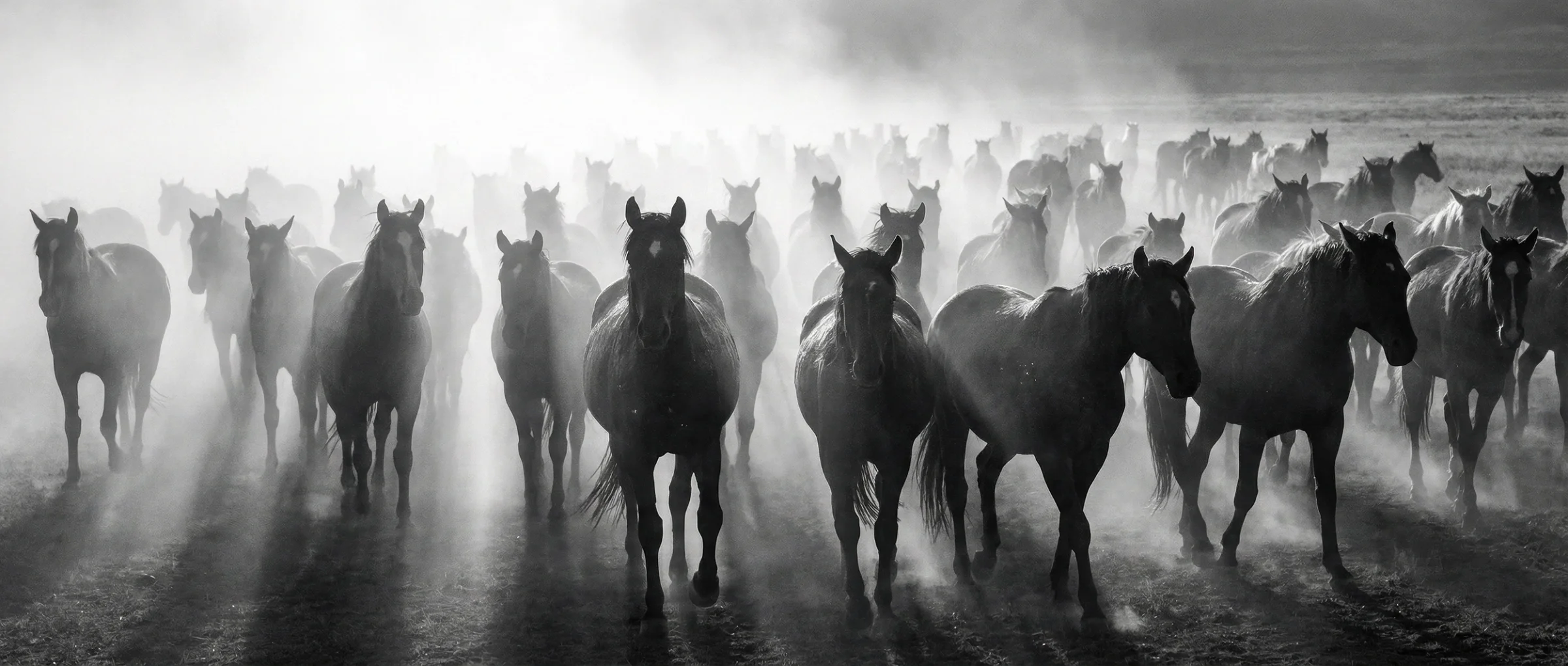
This is the radical gesture of Over the Dunes, and the thing that distinguishes it from both the tradition of desert photography and the tradition of equine art. In this collection, the horse exists not as subject but as element — a geological force equivalent in visual weight to the dune, the sky, the horizon line. The animals are not portraits in the conventional sense. They are not named, not posed, not isolated against studio backdrops. They move through a landscape that is their own, casting shadows that merge with the shadows of the dunes, their musculature rhyming with the rippled contours of the sand beneath them.
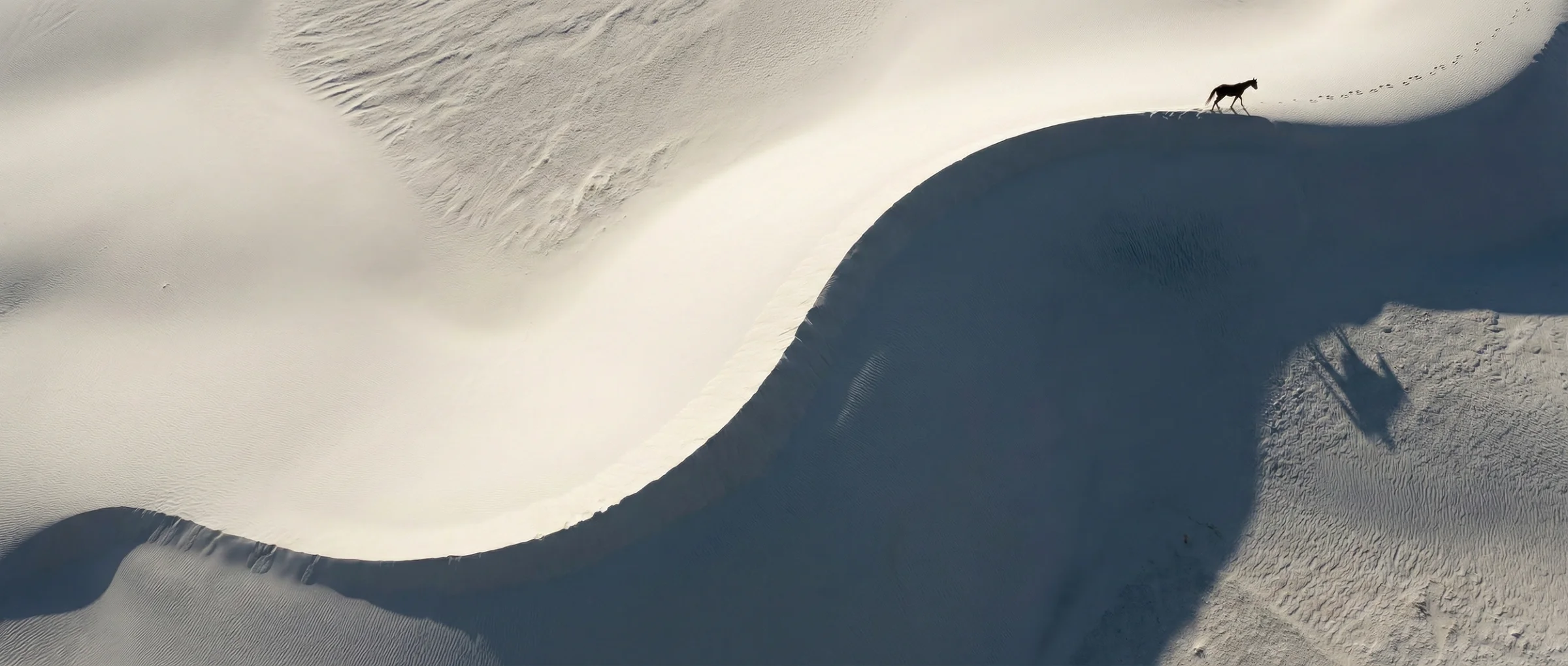
By placing the Arabian horse — a breed whose bloodlines have been refined across millennia in precisely this landscape — back into the desert environment that shaped it, and by recording the encounter in monochrome, I found that the distance between animal and earth collapsed entirely. The horse does not stand on the sand. It emerges from it. The distinction between organic and geological dissolves. Muscle and dune share the same tonal vocabulary, the same sculptural grammar, the same relationship to light. In certain images — particularly the panoramic compositions where a single figure traverses the ridge of a vast dune — it becomes genuinely difficult to determine where sand ends and horse begins. This is not ambiguity. It is unity.
The compositions are characterised by vast expanses of negative space — fields of sand or sky that occupy sometimes seventy or eighty percent of the image area, pushing the equine figure to the margin or reducing it to a single dark accent against an immensity of tone. The effect recalls the spatial strategies of Japanese ink painting, where a mountain might occupy a small corner of a wide silk scroll while the remainder is given over to mist and void — the principle of ma, the interval, where meaning resides not in what is shown but in what is withheld. These are photographs that refuse to be glanced at. They require, and reward, the kind of sustained attention that the desert itself demands.
The Technology of Presence
Over the Dunes is captured with the Phase One IQ4 150MP — a medium-format digital system whose sensor resolves detail at a level that approaches the grain structure of large-format analogue film. Each raw file contains over one hundred and fifty million discrete points of tonal information, recorded in sixteen-bit depth across fifteen stops of dynamic range. In practical terms, this means the lightest whisper of dawn mist on a dune ridge and the deepest shadow pooled beneath a horse's belly are held simultaneously, with no loss, no compression, no sacrifice of one tonal extreme for the other.
The system is paired with Schneider Kreuznach optics — lenses engineered for medium-format digital sensors with edge-to-edge resolution that maintains microscopic sharpness from the centre of the frame to its outermost corners. At the print sizes for which these images are intended, this optical precision is not a luxury. It is a necessity. A viewer standing before the final print can see individual grains of sand, the texture of wind-carved ridges, the fine hairs along a horse's muzzle, the way light catches the curvature of an ear. The image does not dissolve at close inspection. It deepens. New details emerge the longer one looks, creating the same layered experience of discovery that the desert itself provides.
Every edition is printed on Hahnemühle Photo Rag 308gsm — a museum-grade, one hundred percent cotton rag paper produced by the Hahnemühle mill in Dassel, Germany, a company whose papermaking tradition spans more than four hundred and forty years. The paper is acid-free, lignin-free, and engineered for archival permanence measured in centuries. Its matte surface absorbs pigment without reflection, producing blacks of extraordinary depth and whites that retain the warmth and texture of the cotton substrate. When a viewer stands before a large-format print on this paper, they are not looking at ink on a flat surface. They are looking into the image.
Every print is produced at my own facility, InnFRAME, under controlled conditions with calibrated pigment-based inkjet systems and custom ICC profiles developed for each paper and ink combination. Each print is individually inspected, measured, and signed before it leaves the studio. There is no outsourced production. There is no batch processing. Every print that bears my signature has passed through my hands.
SILÊNCIO: The Desert Arrives in the City
Over the Dunes will be accompanied by SILÊNCIO — an immersive international touring exhibition that transforms gallery spaces into multi-sensory desert environments across five cities over fourteen months. This is not a conventional gallery exhibition. It is a site-specific transformation. Each venue is redesigned from the ground up — its existing identity temporarily suspended and replaced by the desert.
Sand covers the gallery floor. The temperature rises gently. Acoustic engineering eliminates external sound. A subtle scent of dry mineral earth fills the air. Before visitors see a single photograph, their senses have already been transported. They walk through the sand to reach each work — large-format, eighty inches, printed on museum-grade archival paper, isolated on dark walls with enormous breathing room. At the end of the exhibition, a single bench faces the most commanding image. No text, no audio guide, no explanation. Just the viewer, the work, and the silence.
The exhibition will be accompanied by a limited edition monograph — a collector's object conceived not as a record of the photographs but as a continuation of the experience. Printed on Munken Pure uncoated paper with a cloth-bound cover, gold foil details, and a tipped-in original print in the highest edition tier. The book, like the photographs, is designed to endure.
The Work I Was Always Meant to Make
Every collection I have made — the studio portraits, the racing series, the coastal work — was a step toward this one. I did not know that at the time. I know it now. Over the Dunes is the collection where every thread of my practice converges: the generational connection to horses that I inherited from my grandfather and father, the technical mastery of the Phase One system that gives me the resolution to honour what I see, the patience that twenty years of working with prey animals has taught me, and the courage — because that is what it required — to stop controlling the frame and let the desert speak.
The desert, after all, is the landscape that strips away pretence. Everything false is visible in its nakedness. Only what is real survives the exposure. These photographs, made in that unforgiving light, carry the same unforgiving honesty. They do not romanticise the horse or sentimentalise the landscape. They do not reach for drama or spectacle. They simply present, with extraordinary clarity and patience, the fact of two ancient forms — equine and geological — existing together in a silence so profound that it becomes, in the hands of the camera, a kind of music.
I hope, when you see these images, you sense what I sensed standing in that desert — that in the presence of such silence, something sacred becomes visible.