There is a question I am asked more than any other: why do I refuse to use artificial lighting when I photograph horses in the field? It would be faster. It would be more predictable. It would eliminate the hours — sometimes entire days — spent waiting for conditions that may never arrive. From a purely commercial standpoint, the argument for strobes and softboxes is overwhelming. And yet, across more than twenty years and every landscape shoot I have ever conducted, I have never once set up an artificial light source outdoors. Not once.
The answer is not technical. It is philosophical. Artificial light tells the subject what to be. Natural light asks the subject what it already is. That distinction governs everything in my work, and I believe it is the single most important decision a fine art photographer can make.
The Vocabulary of Natural Light
When I am in the field — and for the Over the Dunes collection that means the sand deserts of the American Southwest, where Arabian horses move through the landscape that shaped their breed over millennia — I am not working with one kind of light. I am working with a vocabulary of light, and each word in that vocabulary produces a fundamentally different emotional register in the photograph.
Golden hour — the forty-five minutes after sunrise and before sunset — is the light most people associate with fine art photography, and for good reason. At these angles, sunlight travels through the maximum amount of atmosphere, scattering the short blue wavelengths and delivering a warm, directional beam that wraps around the contours of a horse's body like liquid gold. It is extraordinarily beautiful, and it is where I do some of my most intimate landscape work. But golden hour is not inherently superior to other conditions. It is simply one voice in the choir.
Storm light produces images of an entirely different character. When clouds fracture and a shaft of sun breaks through to illuminate the dunes while the sky behind remains dark and theatrical, the contrast is staggering. The horses are lit from above as though by a Renaissance master, and the surrounding landscape falls into a dramatic chiaroscuro that no studio setup could replicate. Some of my most powerful Over the Dunes images were made in the three to five minutes before or after a desert storm, when the sky is simultaneously the most dangerous and the most beautiful thing in the frame.
Blue hour — those brief minutes before dawn or after the sun has fully set — delivers a cool, diffused light that renders the desert landscape in monochrome even before I convert the image. In these conditions, the distinction between horse and dune, muscle and sand, dissolves. The animals become geological forms, and the landscape becomes animate. It is an eerily beautiful quality of light, and it demands a very different approach: slower shutter speeds, wider apertures, absolute stillness from both photographer and subject.
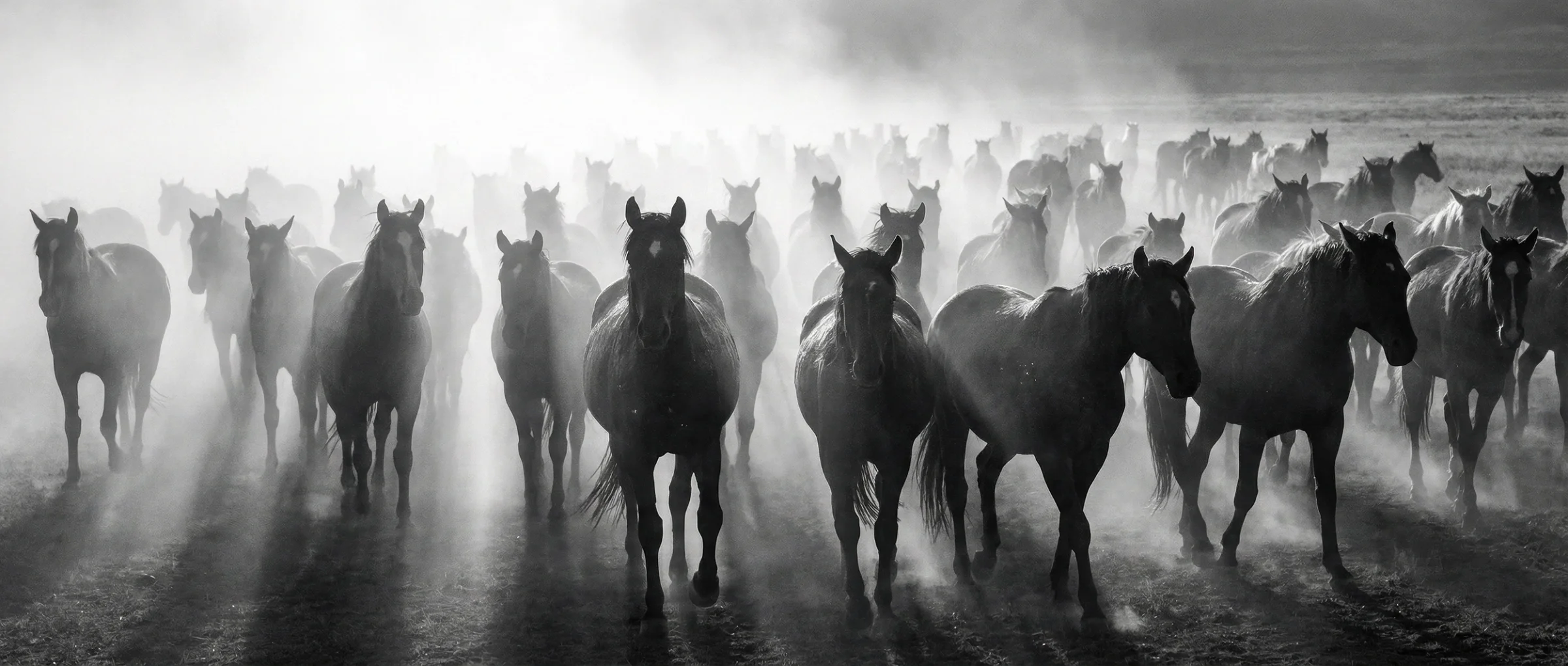
And then there is the light that most photographers avoid entirely: overcast diffusion. A flat grey sky that eliminates shadow, softens every edge, and produces the most delicate tonal gradations. This light is undervalued precisely because it is undramatic. But in monochrome work — and the entire Over the Dunes collection is rendered in strict black-and-white — diffused light reveals subtleties that directional sun obliterates. The fine ripple texture of wind-sculpted sand. The individual strands of a mane at rest. The exact tonal relationship between a horse's coat and the dune behind it.
Artificial light tells the subject what to be. Natural light asks the subject what it already is.
Why Artificial Light Fails in the Field
The objection to artificial lighting is not aesthetic purism. It is practical, ethical, and ultimately creative.
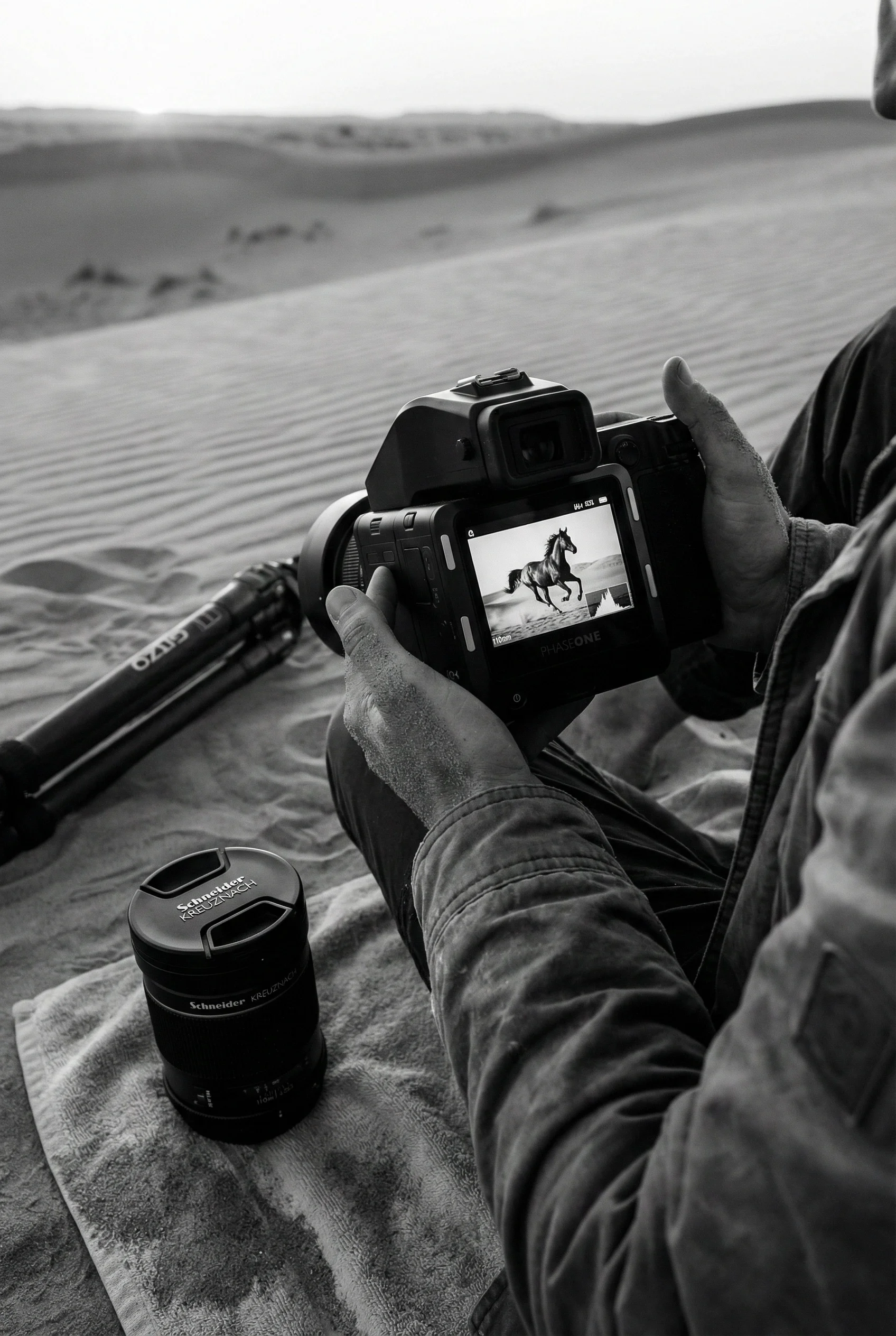
Practically, horses are profoundly sensitive to their environment. A strobe firing — even once — can unsettle an animal that has taken hours to acclimate to my presence. The philosophy I work from is what I call interaction without interference: I am a guest in the horse's space, and my tools must never disrupt the trust that I have spent the day building. A 150-megapixel Phase One sensor is silent. A strobe is not.
Ethically, the commitment to natural light is an extension of a broader principle: I do not manipulate my subjects. I do not pose them. I do not use food, sounds, or physical direction to manufacture behaviour. The horses in my photographs are doing what horses do — and the light falling on them is the light that was there when they chose to do it. This fidelity to the actual moment is what separates fine art from commercial illustration, and it is not negotiable.
Creatively, the restriction is the most powerful force in my work. When you cannot control light, you must learn to read it — to anticipate how it will move across a landscape minute by minute, to understand what the sky is about to do before it does it, to position yourself relative to the subject and the sun so that when the moment arrives, you are exactly where you need to be. This is not passive waiting. It is the most intense form of active observation I know.
Reading the Desert
In the American Southwest — where the Over the Dunes series is primarily shot — the relationship between light and landscape is extreme and unforgiving. The white sand dunes reflect nearly all the light that hits them, creating a natural fill that bounces upward into the undersides of the horses. This is something no studio reflector can authentically replicate, because the quality of bounced desert light carries the texture and temperature of the sand itself. It is warm, diffuse, and vast — it wraps the subject from below with a gentleness that is the exact counterpoint to the directional sun from above.
This interplay — hard directional light from the sky, soft reflected fill from the sand — is what gives Over the Dunes its distinctive tonal character. The horses are simultaneously sculpted and softened. They have dimension and drama, but they also have a quality of integration with the landscape that comes from being lit by the same source, in the same way, at the same moment. They do not stand on the sand. They emerge from it. Muscle and dune share the same tonal vocabulary, the same sculptural grammar, the same relationship to light.
When you cannot control light, you must learn to read it — and that reading becomes the most intense form of active observation I know.
The Phase One Factor
Working with natural light at this level demands extraordinary technical capability. The Phase One IQ4 system that I use — capturing 151 megapixels of information in 16-bit colour depth — is not a convenience. It is a necessity.
When light conditions are changing rapidly — and in the desert, they always are — the camera must be capable of capturing a vast dynamic range in a single exposure. The IQ4's sensor resolves approximately 15 stops of dynamic range, which means I can hold detail in the brightest highlights of white sand and the deepest shadows under a horse's belly simultaneously. This latitude eliminates the need for bracketed exposures or HDR compositing, both of which would be impossible with a living, moving subject.
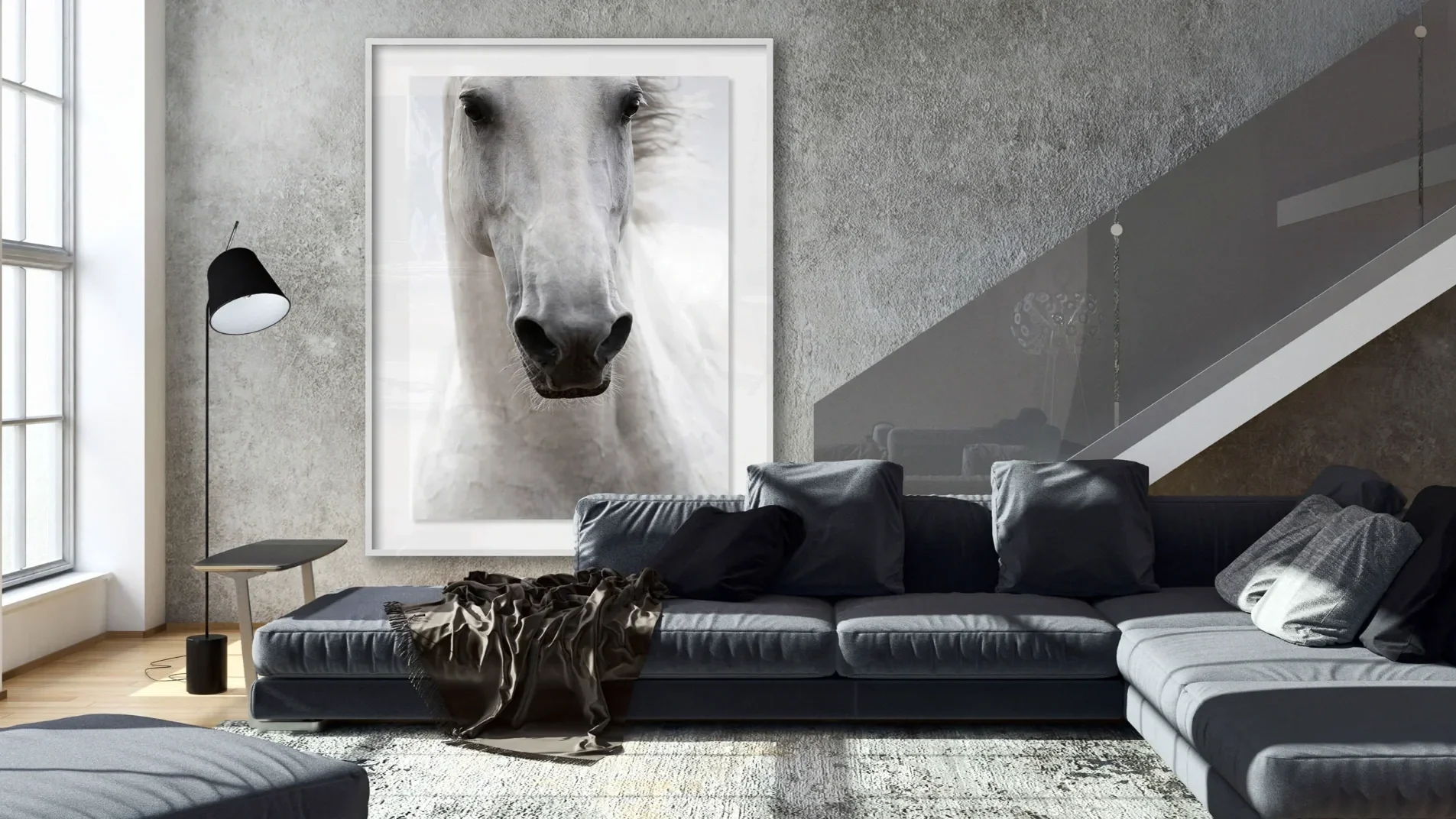
The resolution matters equally. When I print an Over the Dunes image at sixty or eighty inches — which is the scale at which these works are designed to be experienced — every grain of sand, every strand of mane, every contour of muscle must hold. At 151 megapixels, they do. The print rewards close inspection as richly as it rewards the view from across the room. This is what I mean by museum quality: an image that functions at every distance, because the information captured was sufficient to sustain scrutiny at any scale.
Two Collections, Two Approaches to Light
It is worth noting that my commitment to natural light applies specifically to my landscape work — the Over the Dunes collection and its sister series. In the studio, where I produce the intimate portraits of the Equine Beauty collection, light is sculpted deliberately: a single primary source shaped to create Baroque chiaroscuro, isolating each subject against sacred darkness.
These two approaches are not contradictory. They are complementary expressions of the same principle: light should serve the encounter between viewer and subject. In the landscape, the encounter is between horse and earth, so the light must be the light of the earth — natural, unmanipulated, and honest. In the studio, the encounter is between horse and viewer, so the light must be intimate, directional, and sculptural — carving the subject from darkness the way Caravaggio carved saints from shadow.
In both cases, the light is never decorative. It is never added to make the image prettier. It is structural. It is the architecture that shapes how the viewer meets the subject. Get the light right, and every other element — composition, timing, post-production — falls into place. Get it wrong, and no amount of technique will save the image.
Light is never decorative. It is structural — the architecture that shapes how the viewer meets the subject.
The Patience That Light Demands
On a typical Over the Dunes shoot, I arrive at the location before first light. I watch the sky develop. I read the cloud formations. I observe how the horses move through the landscape as the sun rises and the temperature shifts. I may wait three, four, six hours for conditions that last ninety seconds. I may wait and they never come at all.
In twenty years, I have learned something about this waiting that applies far beyond photography: the conditions you cannot control are the conditions that produce the most extraordinary results. An artificial light gives you exactly what you ask for. Natural light gives you what you did not know to ask for — and those are, without exception, the images that stop people in their tracks.
I shoot conservatively — fifty to eighty frames in a session, selecting three or four for the final collection. The discipline is not about scarcity for its own sake. It is about attention. When you know you are working with finite, unrepeatable light, you do not fire the shutter casually. Every exposure is a commitment, a decision that this particular confluence of subject, landscape, and light is worth the permanent record of a 150-megapixel capture.
This is the economy of restraint that natural light enforces. And it is, I believe, the reason the resulting images carry a quality that viewers recognise immediately, even if they cannot articulate what they are sensing: the unmistakable feeling that what they are looking at actually happened — that a horse, a dune, and a shaft of desert light conspired, just once, to produce something unrepeatable.
That is the art of natural light. Not controlling it. Not replicating it. Simply being present, prepared, and patient enough to receive what it offers.