Most equine photography keeps its distance. A profile at golden hour. A full body in motion against a dramatic sky. The eye is invited to admire but never to enter. When I began developing the Equine Beauty collection, I wanted to close that distance completely — to remove everything between the viewer and the animal until looking at the photograph felt indistinguishable from being looked at.
This was not a technical challenge. It was a philosophical one. To create portraits of genuine presence, I had to rethink everything I knew about equine photography — the distance, the environment, the very purpose of the camera. The result is a body of work that I consider the most intimate and demanding of my career: studio portraits that are not portraits of anatomy, but portraits of encounter.
I want to take you behind the making of this collection — not just the process, but the thinking that governs every decision, from the first moment of silence in the studio to the final archival print.
Closing the Distance
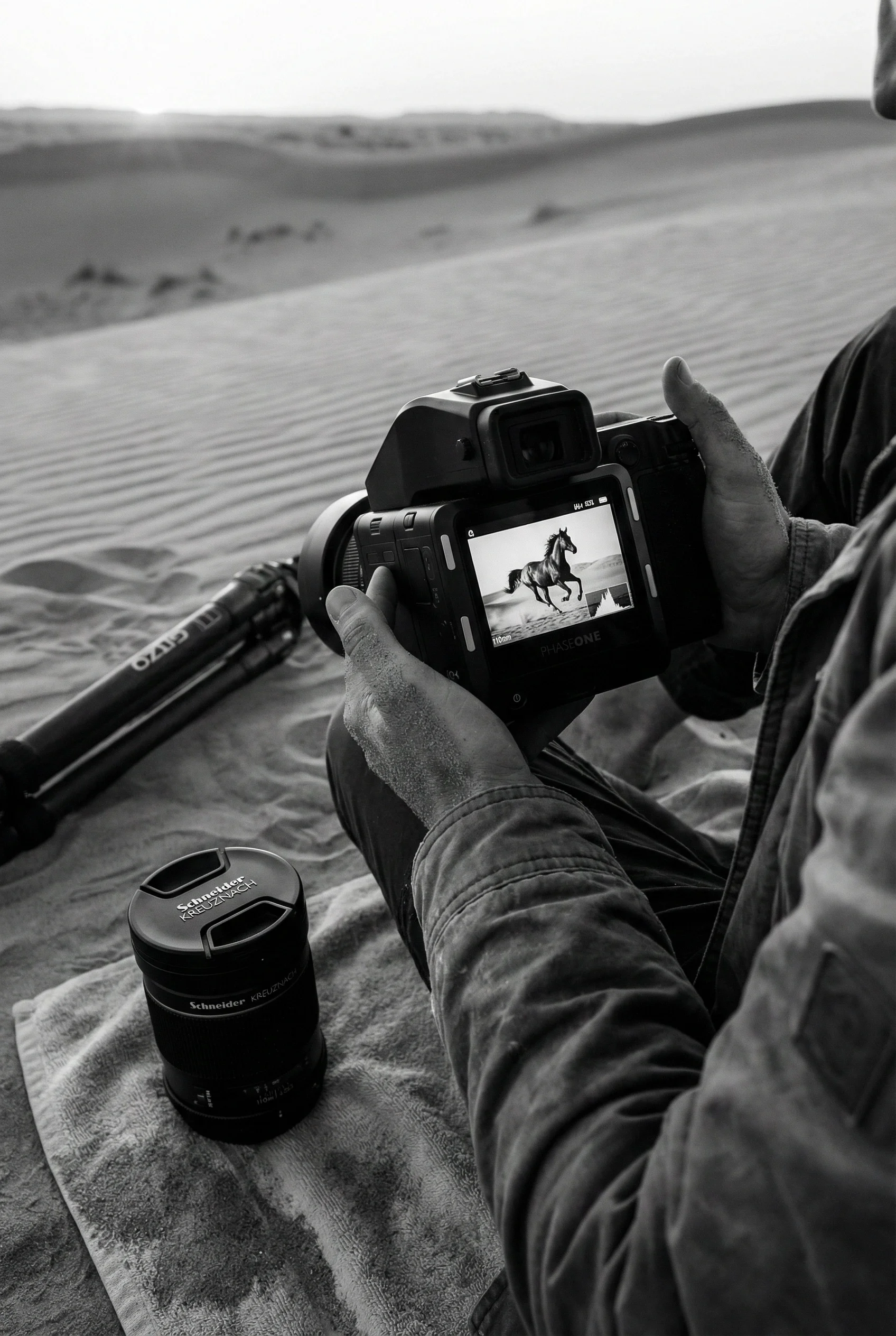
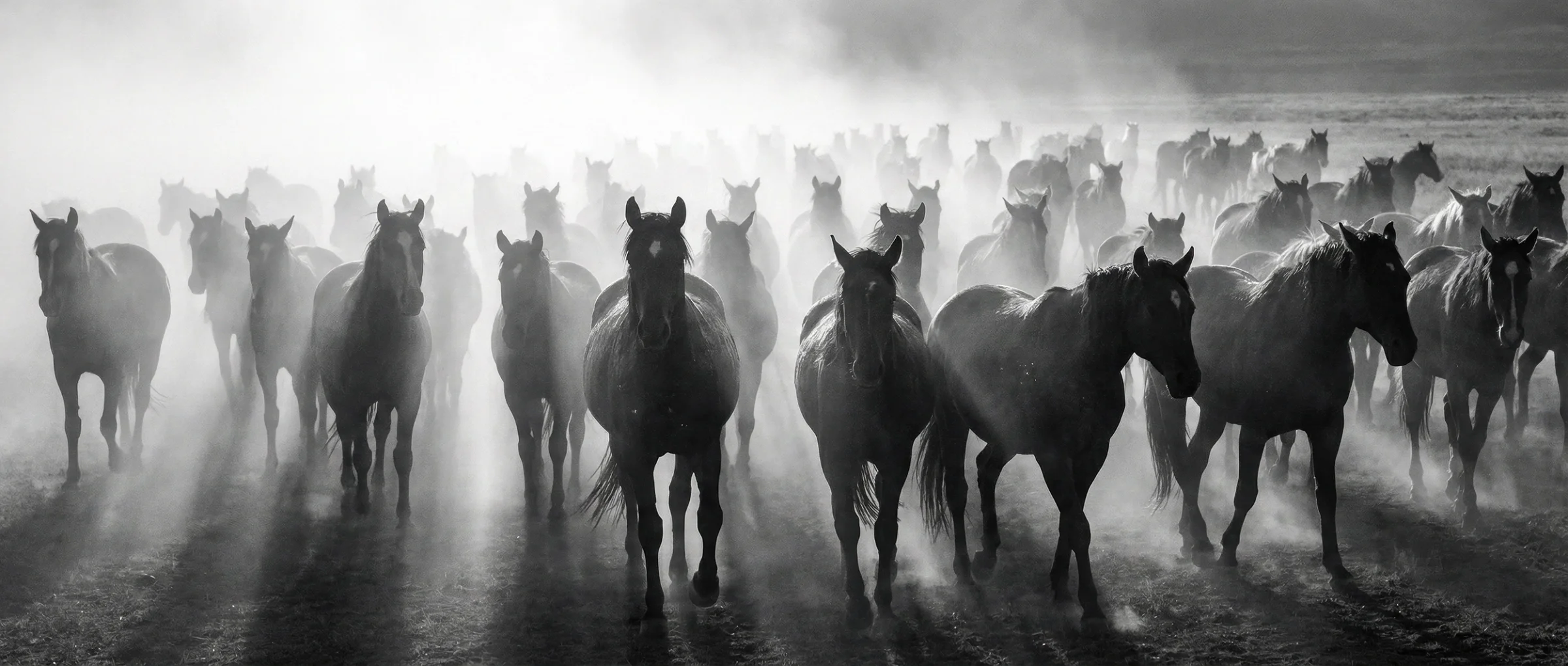
My other major body of work, Over the Dunes, photographs the outward — force, motion, landscape, the relationship between horse and wilderness. Herds in motion across vast desert panoramas, rendered in strict monochrome. The energy is explosive, elemental, primordial.
Equine Beauty is its exact opposite. Where Over the Dunes captures the horse as a force of nature, Equine Beauty captures the horse as a mirror of consciousness. The scale shifts from panoramic to intimate. The palette shifts from monochrome to warm colour — chestnut, amber, cognac, the tones of old libraries and sacred spaces. The environment shifts from open desert to controlled studio, where every photon of light is sculpted with intention.
But the most important shift is psychological. In the studio, there is nowhere for the horse to hide. And — crucially — there is nowhere for the photographer to hide either. The encounter is direct, proximate, and honest in a way that landscape photography, however dramatic, cannot replicate. When I photograph an Arabian stallion at a distance of three feet, with a 150-megapixel sensor rendering every strand of mane and every flicker of the iris, I am not documenting appearance. I am recording the quality of a meeting between two living beings.
These are not photographs of horses. They are portraits of presence — the irreducible encounter between two living things separated by a lens.
The Studio as Chapel
The studio environment for Equine Beauty is spare to the point of austerity. A single horse. A dark backdrop — sometimes absolute black, sometimes a deep, textured darkness that holds warmth in its shadows. And light. Always a single primary source, sculpted to reveal form the way a Renaissance master would illuminate a face emerging from shadow.
I think of the lighting as chiaroscuro in the most literal sense — the interplay of light and dark that Caravaggio and Rembrandt used to create the sensation of a figure emerging from sacred darkness. In those paintings, the darkness is not absence. It is a kind of presence, a charged space from which the subject materialises. I want the same quality in every Equine Beauty portrait: the feeling that the horse has not been placed against a black background, but has emerged from it, the way a thought surfaces from silence.
The single-source lighting is the key. Commercial equine photography tends to use multiple light sources — fill lights, rim lights, hair lights — to ensure every detail is evenly visible. I reject this completely. In Equine Beauty, the light is selective. It finds certain muscles, certain curves, certain textures, and lets everything else fall into shadow. The result is sculptural: the horse is not flat and fully illuminated but three-dimensional, carved from darkness by light, revealing its architecture with the precision of a chisel on marble.
Photographing the Inward
Every portrait in this collection captures what I call the inward — not the gallop, not the rear, not the outward display of power that defines most equine imagery, but the breath before movement, the stillness after thought, the sovereign withdrawal into a selfhood older than any language we possess.
This is the hardest thing to photograph, and the most rewarding. A horse in motion is dramatic, but it is essentially performing — responding to stimulus, expressing energy outward. A horse in stillness, truly at rest in the presence of the camera, is doing something far more remarkable: it is choosing to be seen. And that choice, when it comes, produces an image of extraordinary power.
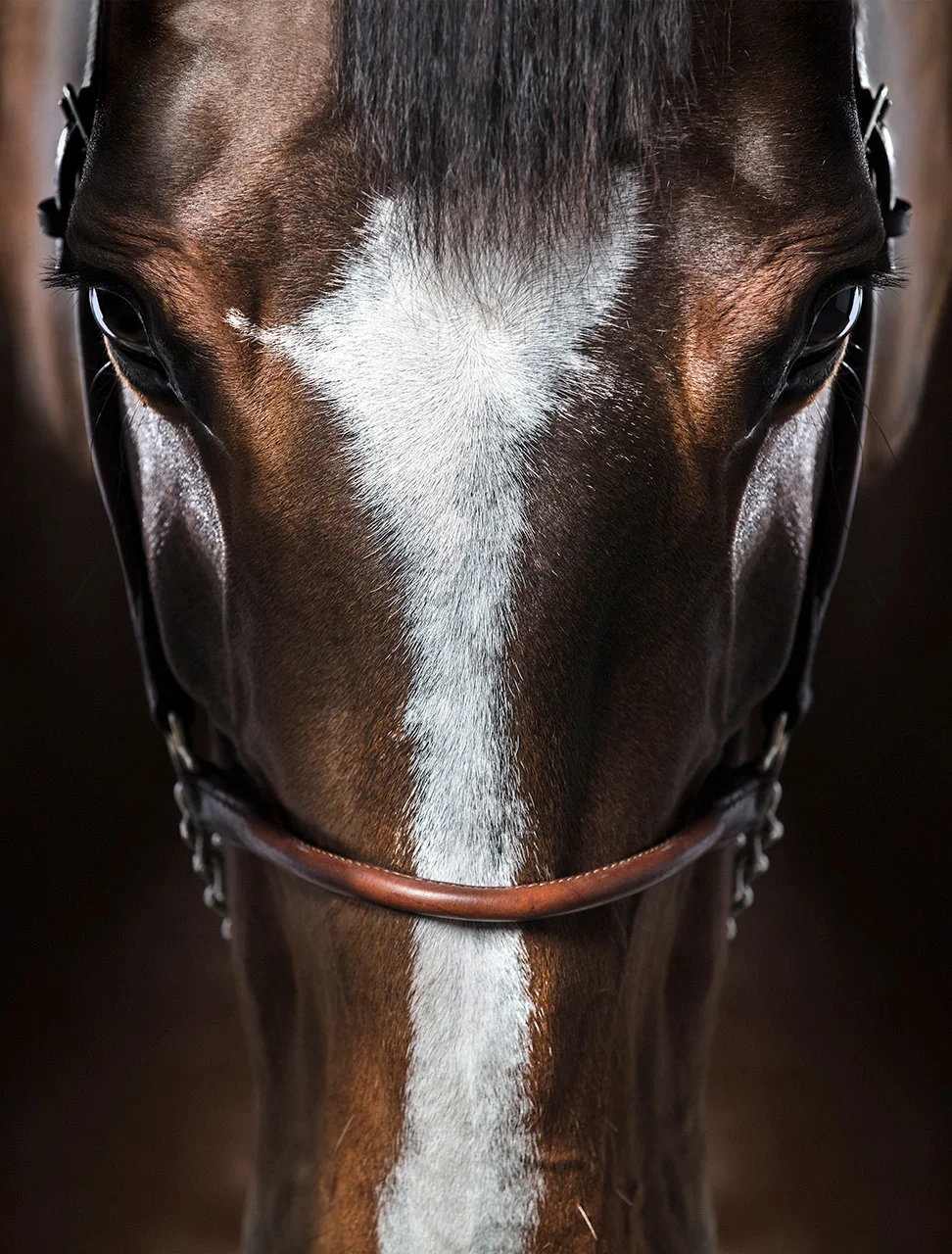
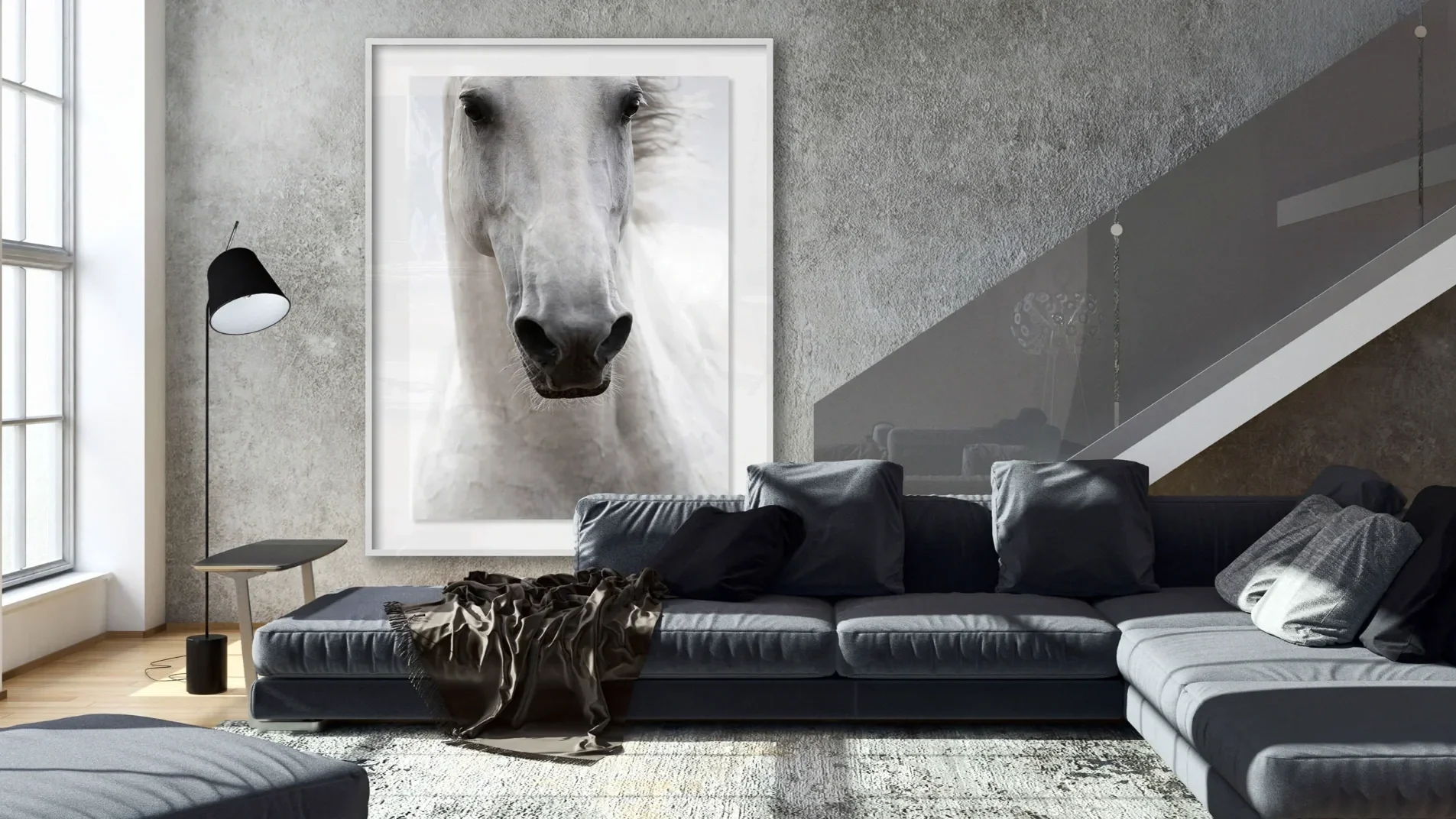
Take Immersion, the collection's flagship work. A bay stallion in absolute bilateral symmetry, a white blaze running vertically down the centre of the face like a stroke of calligraphy. The gaze is frontal — direct, unguarded, confrontational in the truest sense. The warm colour palette is retained: chestnut, amber, cognac. This is the portrait that looks back. It is, of all the works in the collection, the one that most often stops viewers in their tracks, because the encounter it creates is not aesthetic. It is personal.
When a horse turns inward, it becomes something more than an animal. It becomes a question the viewer must answer with their own silence.
The Portraits: Six Modes of Encounter
Each artwork in the collection occupies a distinct emotional and compositional territory. No two works share the same gesture, gaze direction, or encounter type. The collection reads as a conversation between different modes of presence:
Immersion — total absorption. The frontal gaze, the bilateral symmetry, the warmth of chestnut and amber. The portrait as direct encounter. You do not look at Immersion. It looks at you.
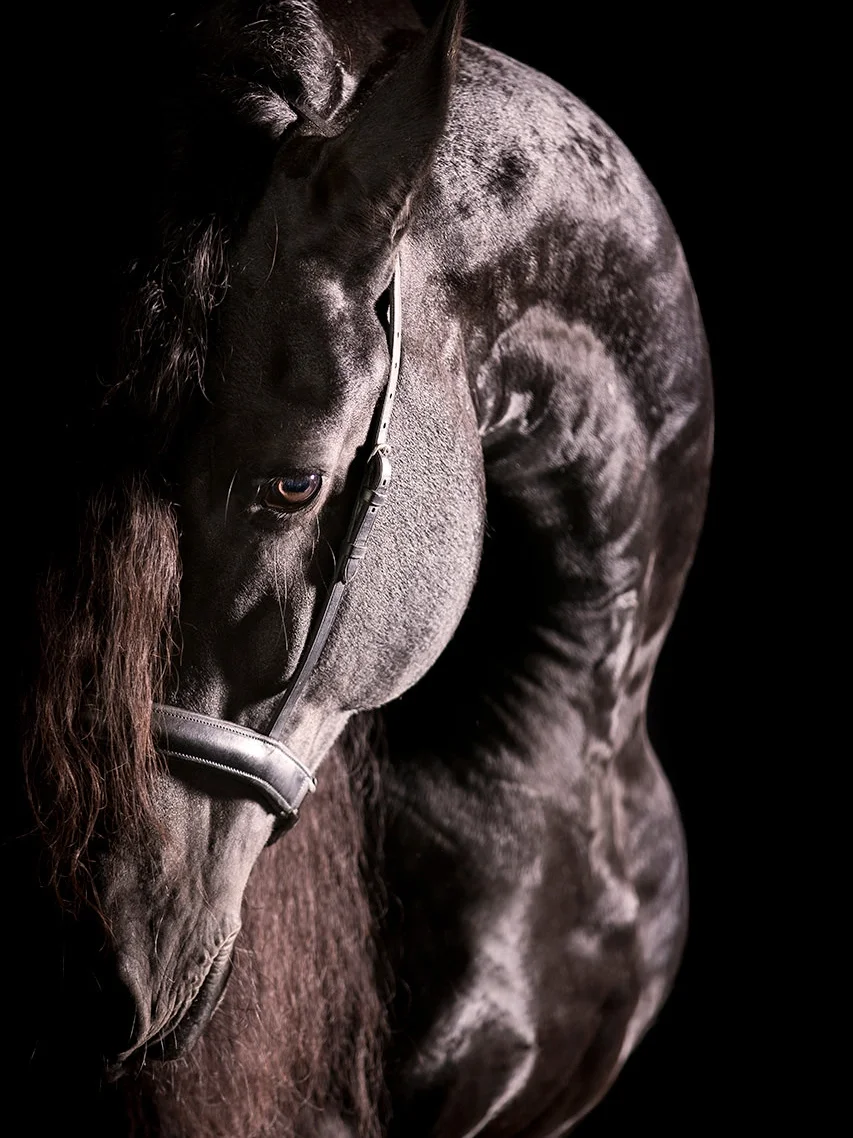
Curvarum — the architecture of the curve. Neck and mane forming an S-curve against darkness, revealing the geometry that has captivated artists since the Parthenon frieze. Pure form. Pure mathematics rendered in muscle and hair.
Lucernis — by the light. A luminous one. The horse's eye catches a single point of reflected light, creating an anchor of intelligence within the surrounding darkness. The entire composition orbits that single point.
Tutor — the guardian. The protector. The watcher. A three-quarter profile with an amber eye, the head slightly elevated, alert not with anxiety but with quiet authority. The sentinel.
Epic — not in the sense of spectacle, but in the sense of scale of spirit. A close crop that fills the frame, eliminating all context, until the viewer is confronted with nothing but the density of the subject's presence.
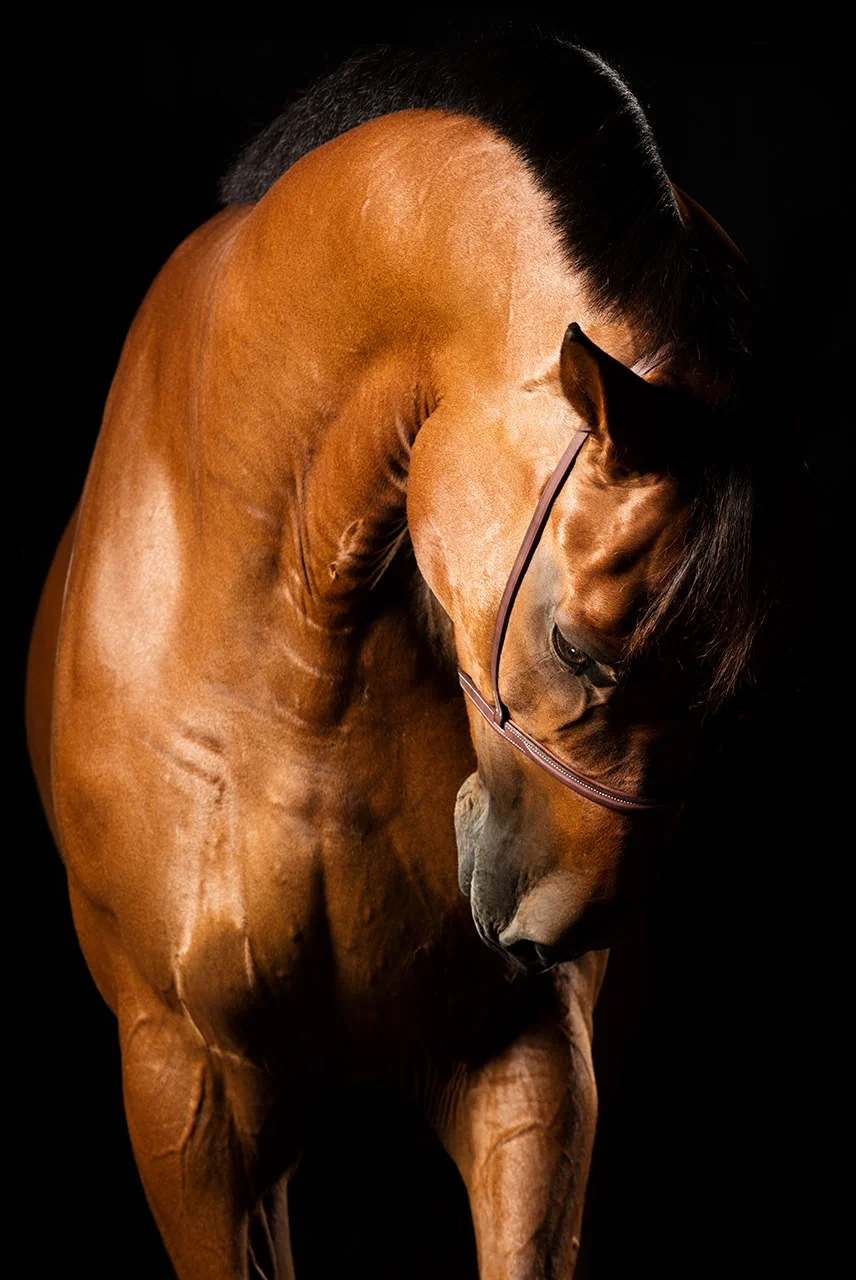
Maiesta — the bow, the weight of grace. A bay horse lowers its head in a slow, contemplative arc — not in submission, but in the sovereign act of choosing stillness over spectacle. The mane cascades, the neck curves with the precision of calligraphy, and the light finds every muscle as though it has been waiting centuries to illuminate exactly this.
The Threshold Between Observer and Subject
There is a concept at the heart of Equine Beauty that governs everything: the threshold. The thin border between looking at a photograph and entering it. Between observing a horse and being in the presence of one.
Every technical decision I make — the sculptural lighting, the forensic detail of the Phase One system, the 16-bit colour depth that preserves every warm tone from chestnut to cognac, the Hahnemühle Photo Rag 308gsm that gives each print a physical depth and texture — serves the same purpose: to make that threshold as thin as possible. When a collector stands before an Equine Beauty portrait at sixty or seventy inches, printed with archival pigment inks rated for two hundred years, the experience should not be that of looking at a photograph. It should be the experience of crossing over — from observer to participant, from seeing to being seen.
You do not decide to enter these portraits. You simply realise you already have.
The technique is sculptural, the detail forensic, the patience infinite. But everything serves a single purpose — to make observation feel indistinguishable from communion.
Where Observation Becomes Communion
The Equine Beauty collection continues to grow. Each new work must earn its place by occupying a territory — emotional, compositional, chromatic — that no existing portrait claims. The collection is a conversation, not a series of repetitions, and each addition must say something the others cannot.
What unites every work is the conviction that a photograph can do more than record appearance. It can create an encounter. It can hold a quality of presence so charged that the viewer's relationship to the image changes — from admiration to something closer to recognition, the uncanny sense of being in the company of an intelligence older than speech.
That is the territory this collection inhabits. Not beauty in the decorative sense, though these portraits are undeniably beautiful. Beauty in the sense the Old Masters understood it: a threshold experience, a moment in which the observed and the observer become, however briefly, indistinguishable.
Where observation becomes communion.