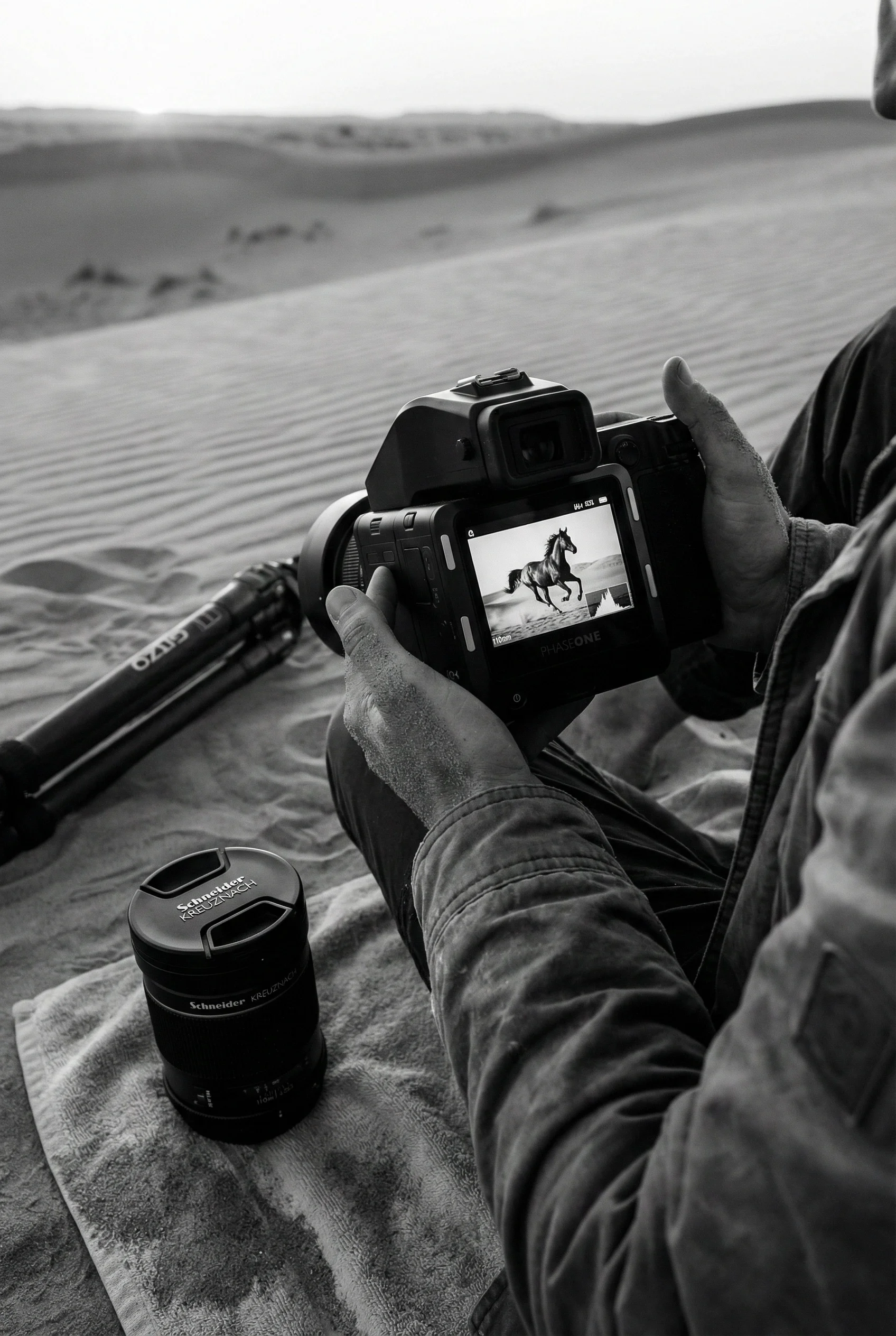
There is a moment — and it is always unexpected — when a horse decides to trust you. It cannot be hurried. It cannot be manufactured. It arrives in its own time, announced by nothing more than a softening of the eye, a lowered head, a breath released. In more than twenty years of photographing horses across four continents, I have learned that this moment is the only one that matters. Everything I do — every hour of silent presence, every sunrise spent simply observing, every technical decision made with the Phase One before it is ever raised to my eye — exists in service of that single, unrepeatable instant.
I call my approach interaction without interference. The name is deliberate. I am not a passive observer, hidden behind a telephoto lens at a safe distance. I am there, fully present, within the animal's space. But I am not directing, not controlling, not asking the horse to perform for my camera. I am waiting — with every sense alert — for the horse to reveal who it truly is.
This is, I understand, a deeply unfashionable way to work. We live in an era that rewards speed, volume, efficiency. Photographers are expected to arrive, execute, and leave. A commercial shoot might allow an afternoon. A portrait session, an hour. The idea of spending two or three days with a subject before pressing the shutter — simply to earn the right to photograph them — sounds, to many, like indulgence. I see it as the only honest approach.
The Language Before Language
Horses do not lie. They are incapable of pretense. A horse that is anxious will show you anxiety in the set of its ears, the tension of its neck, the rhythm of its breathing. A horse that is at ease will show you that too — in a way so complete, so unguarded, that it can take your breath away. This radical honesty is precisely what makes equine photography both the most challenging and the most rewarding discipline I know.
My training in veterinary medicine in Brazil — before I ever picked up a camera — gave me a clinical understanding of equine physiology. I can read a horse's body the way a cardiologist reads an ECG: systematically, precisely, in real time. But the deeper education came earlier, in the stables of my family's farm near São Paulo, where my father — a horse breeder and veterinarian himself — taught me something no university could: that the relationship between a human and a horse is not one of dominance, but of conversation.
The most powerful photographs emerge when the horse feels completely at ease — when the camera becomes invisible.
That word — conversation — is important. A conversation requires listening. It requires responding to what you hear rather than projecting what you want to say. When I enter a stable or a paddock or a desert landscape for the first time, I am not thinking about composition or light or the technical capabilities of my 150-megapixel sensor. I am listening. I am reading. I am making myself known to the horse in the most unobtrusive way I can manage, and then I am waiting for the horse to make itself known to me.
This process has no fixed timeline. With some horses — particularly those that have been around respectful humans their entire lives — it can happen within hours. With others, especially those who have known rough handling or who are simply wary by temperament, it may take days. I have traveled to locations on three separate occasions before achieving the single image I was seeking. Each time, I left without pressing the shutter. Each time, I considered it time well spent, because the relationship was being built.
The Architecture of Trust
There is a practical dimension to this philosophy that I think is worth articulating, because patience is not merely a romantic ideal — it is a technical necessity.
A horse that is uneasy will carry that unease in every fiber of its being. The muscles along the topline will hold a subtle tension. The nostrils may flare almost imperceptibly. The tail will carry differently. To the casual observer — even to many experienced equestrians — these signals may go unnoticed. But a camera operating at 150 megapixels does not forgive. At the level of resolution I work with, every whisper of tension is recorded. Every micro-expression is preserved. The difference between a horse that is tolerating the camera and a horse that has genuinely forgotten the camera exists is, in the final print, the difference between a good photograph and a transcendent one.
I learned this the hard way. In my earlier years, working at a faster pace, I would sometimes return from a session with hundreds of technically accomplished images — sharp, well-exposed, beautifully composed — that were, when I examined them honestly, empty. They were photographs of horses performing the role of being photographed. They were not photographs of horses being themselves.
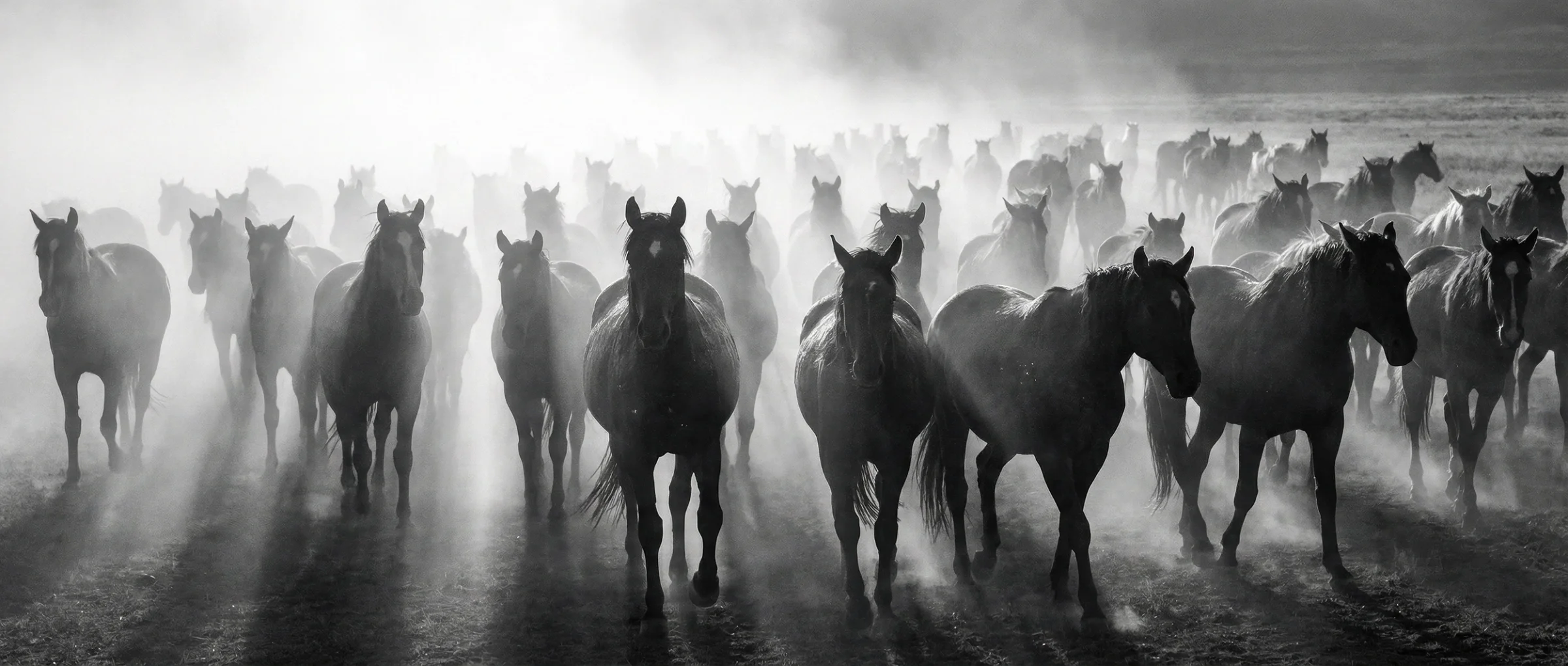
The horse appears not to have been photographed, but to have chosen to be seen.
That distinction changed everything for me. I began to understand that what collectors responded to in my strongest work — what made certain images stop people in their tracks at Paris Photo or Art Basel — was not technical perfection, though the technical standard was high. It was presence. The animal was there in the image, fully and authentically, in a way that felt almost startling. As though the horse had looked at the camera and decided, in that moment, to let you see it.
Why Natural Light Is Non-Negotiable
I never use artificial lighting. This is not a preference. It is a principle. A horse that has spent millennia evolving in open landscapes — whose every instinct is tuned to the movement of sun and shadow, to the particular quality of light before a storm or at the edge of dawn — cannot be asked to stand under a studio strobe without something essential being lost.
Artificial light, no matter how skillfully deployed, creates a kind of visual fiction. The horse is lit; it is not illuminated. There is a world of difference. When I wait for the right natural light — and I may wait hours for it, or return day after day until the conditions align — what I am really waiting for is the moment when the landscape and the animal and the quality of the atmosphere conspire to reveal something true. The light at 6:47 in the morning in the American Southwest, cutting low across a mesa with the faintest trace of desert dust suspended in the air, creates something that no modifier or softbox can replicate. It creates atmosphere. And atmosphere is what elevates a photograph from a record of appearance to an experience of presence.
The Sacred Economy of Restraint
I am often asked how many images I capture during a session. The answer surprises people. On a typical day in the field — after hours of observation and silent engagement — I may press the shutter between fifty and eighty times. From a multi-day project, I may present three or four final works. From an entire year of shooting, I will release perhaps ten to fifteen new editions.
This economy is intentional. Each image that bears my name must meet a standard that I can only describe as emotional truth. Technical excellence is a baseline — the resolution must be flawless, the tonal range immaculate, the print capable of holding its detail at monumental scale. But beyond that, the image must do something that is far harder to define: it must hold a charge. When a collector stands before one of my prints at full scale — sixty, seventy, eighty inches — I want them to feel the presence of the animal as though it is breathing in the room. That requires a level of authenticity that cannot be manufactured after the fact. It must be present in the moment of capture.
A good photograph is more than a beautiful picture; it encompasses a wide range of emotions that tell the entire story of a moment frozen in time.
This is why patience is not an accessory to my practice. It is the practice. The hours of waiting are not dead time before the real work begins. They are the work. They are the process by which trust is established, presence is earned, and the conditions — both emotional and environmental — align to produce something that justifies pressing the shutter.
Twenty Years, Zero Incidents
There is a detail about my career that I share not as a boast, but as evidence: in more than two decades of working in close physical proximity to horses of every breed, temperament, and background — including stallions in full display, wild herds in open desert, and animals I was meeting for the first time — I have never experienced a single incident. No kick. No bite. No charge. Not once.
I offer this fact because it speaks directly to what patience makes possible. A horse will not harm what it does not perceive as a threat. And to not be perceived as a threat, you must genuinely not be one. You must enter the animal's world without agenda, without urgency, without the particular kind of psychic noise that horses — with their extraordinary sensitivity to intention — can detect instantly. The camera, in my hands, is never a weapon aimed at a subject. It is an extension of attention. And when that attention is offered with enough care, over enough time, the horse receives it as what it is: an act of respect.
An Invitation to Slowness
I sometimes wonder whether the photographs that emerge from this process are, in some sense, an argument for slowness itself — for the radical proposition that some things simply cannot be rushed, and that the attempt to rush them destroys the very quality we were seeking.
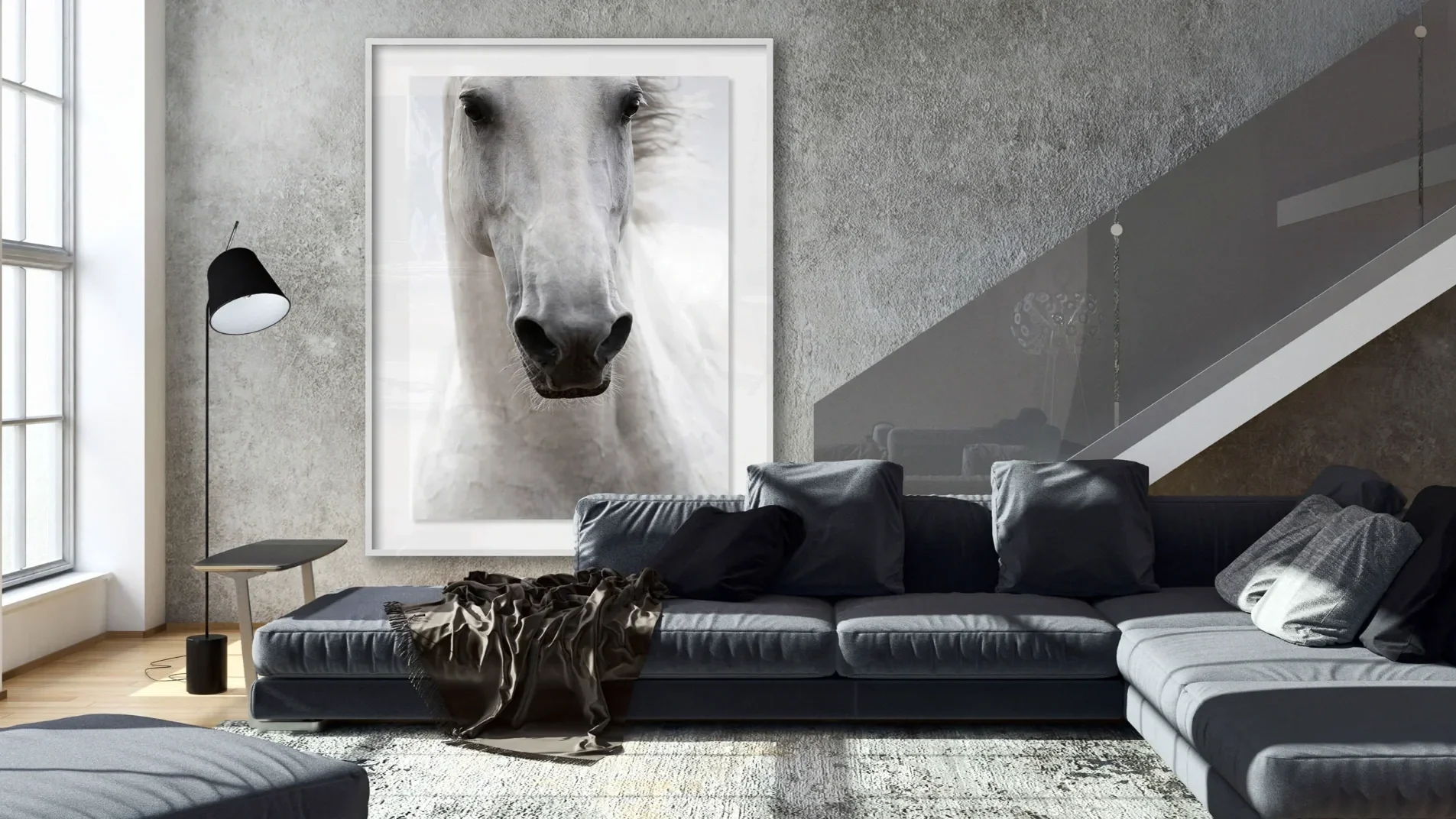
The collector who hangs one of my prints in their home is, I believe, responding to something more than the beauty of the horse or the drama of the landscape. They are responding to the time that went into the image — to the patience that is somehow visible in the final result, even if they couldn't articulate exactly how. There is a quality in these photographs that is the direct product of unhurried attention, and I believe people feel it.
In a world that moves faster every year, perhaps there is something quietly revolutionary about an image that was made slowly. That asked nothing of its subject. That waited, and was rewarded not with a pose, but with a revelation.
That is the philosophy of patience. It is very simple, and it takes a lifetime to practice.