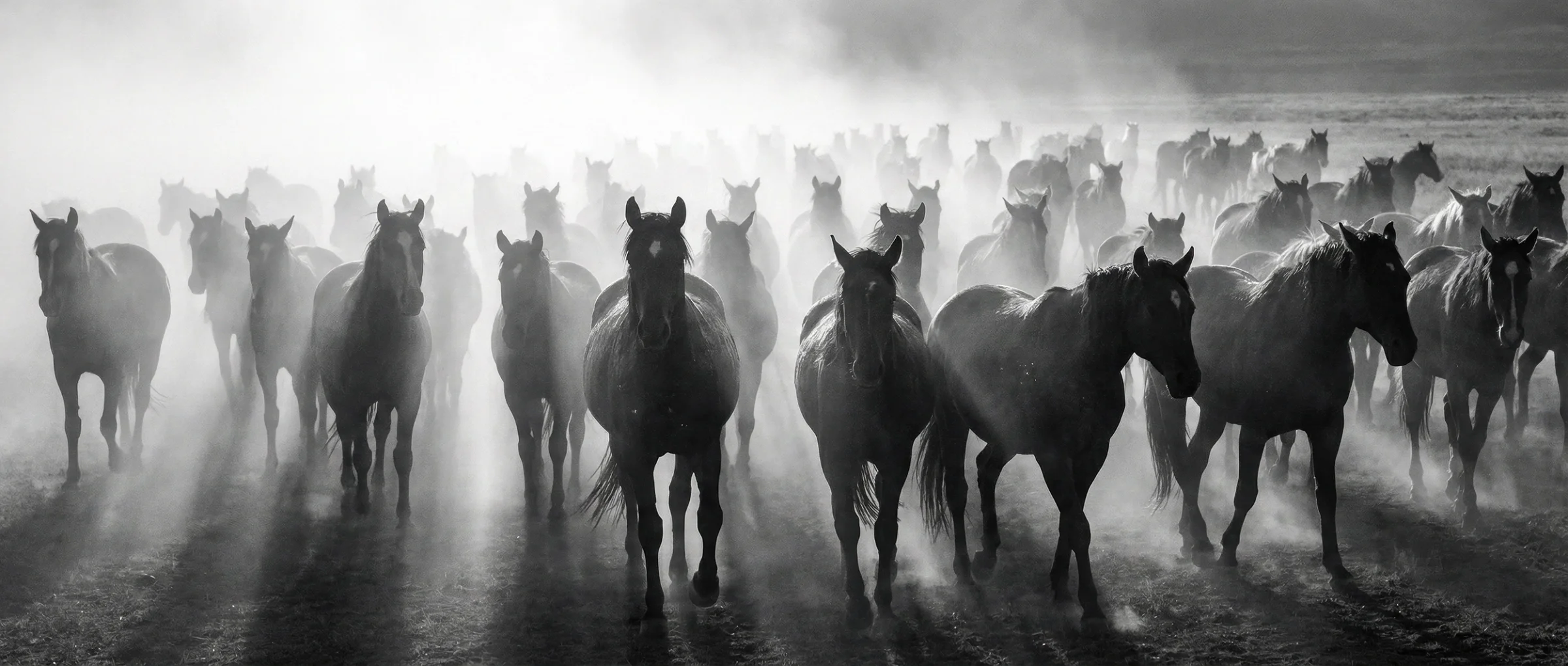
Stand in a courtyard in Jerez de la Frontera at dawn, before the heat has arrived and before the tourists have found the sherry bodegas, and watch a Pura Raza Española stallion being led across the cobblestones. The sound of iron on stone. The arc of a neck that carries five centuries of selective breeding in its curve. The way the morning light catches the coat — grey dissolving into white, white dissolving into pearl — and you will understand, in a single breath, why the Spanish have never considered these animals merely horses. They are cultural artefacts. They are architecture in motion. They are, in the most precise and literal sense, living art.
I have photographed horses across four continents — Arabians in the American desert, Thoroughbreds on the English downs, Lusitanos along the Portuguese coast, wild Mustangs in the sagebrush of the Great Basin. But the Andalusian occupies a singular position in my work and in the broader history of equine art, and to explain why requires going back to the very beginning: not to the founding of the breed, but to the moment humanity first recognised that certain horses were not merely useful, but beautiful.
The Horse That Shaped the Western Eye
The Pura Raza Española — the Pure Spanish Breed, known universally as the Andalusian — is one of the oldest recognised horse breeds in the world. Its origins trace to the Iberian Peninsula, where cave paintings at Altamira and El Castillo depict animals with the same convex profile, the same high-set neck, the same powerful hindquarters that define the breed today. These are horses that predate written language. They predate agriculture. They are older, as a recognisable type, than civilisation itself.
But it was the Carthusian monks of the fifteenth century who transformed a regional type into something extraordinary. In their monasteries outside Jerez, Seville, and Córdoba, these monks — meticulous record-keepers with an aesthetic sensibility sharpened by centuries of illuminated manuscripts and cathedral architecture — began a breeding programme that would produce what many equine scholars regard as the most aesthetically refined horse the world has ever seen.
The monks selected not only for function — the Andalusian is an exceptional working horse, compact and powerful, with an intelligence that borders on the uncanny — but for form. They bred for the baroque profile: the convex nose, the wide-set eyes that give the breed its expression of alert serenity, the massive crest that rises from the withers like the prow of a ship. They bred for movement: the elevated, cadenced trot that seems to suspend the animal between earth and air, the collected canter that carries the horse upward rather than forward. And they bred for presence — that indefinable quality, known in Spanish as nobleza, that makes an Andalusian in a field of horses impossible to overlook.
These are horses that predate written language. They predate agriculture. They are older, as a recognisable type, than civilisation itself.
Painted Before They Were Photographed
Long before the camera, the Andalusian was the horse of painters. Velázquez placed them beneath Philip IV in compositions that defined royal portraiture for two centuries. Rubens sought them obsessively, importing Spanish stallions to Flanders so he could study their movement in his studio. Van Dyck, Goya, Delacroix — the lineage of European masters who built their equestrian compositions around the Iberian horse reads like a syllabus of Western art history. And the reason was always the same: no other horse offered this combination of sculptural mass and fluid grace.
Look at Velázquez's Prince Baltasar Carlos on Horseback, painted around 1635. The horse — unmistakably an Andalusian, with its arched neck, rounded croup, and abundant mane — occupies more of the canvas than the prince himself. It is not a prop. It is not a vehicle. It is the emotional centre of the painting: the thing that tells you this child commands something vast and ancient and alive. Velázquez understood what every equine artist since has had to learn: the Andalusian does not merely carry its rider. It transforms its rider.
This painterly heritage matters deeply to how I approach the breed through the lens. When I photograph an Andalusian, I am not documenting an animal. I am working within a visual tradition that stretches back four hundred years — a tradition in which this particular horse has always been understood as a subject worthy of the highest artistic ambition.
The Sculptor's Horse
Among photographers who work seriously with horses, a quiet consensus exists: the Andalusian is the most sculptural breed in the world. This is not subjective opinion. It is an observation rooted in the animal's physical architecture.
The Andalusian's body is built in volumes. Where a Thoroughbred is angular, lean, constructed of planes and edges that catch directional light in sharp, graphic ways, the Andalusian is curved. The neck arcs. The shoulder rounds. The hindquarter swells into a muscled dome that, when lit from the side, creates tonal gradations as subtle and continuous as a Bernini marble. The mane and tail — often extraordinarily thick and long — add a secondary layer of sculptural complexity, behaving in wind and motion like fabric in a Renaissance bronze.
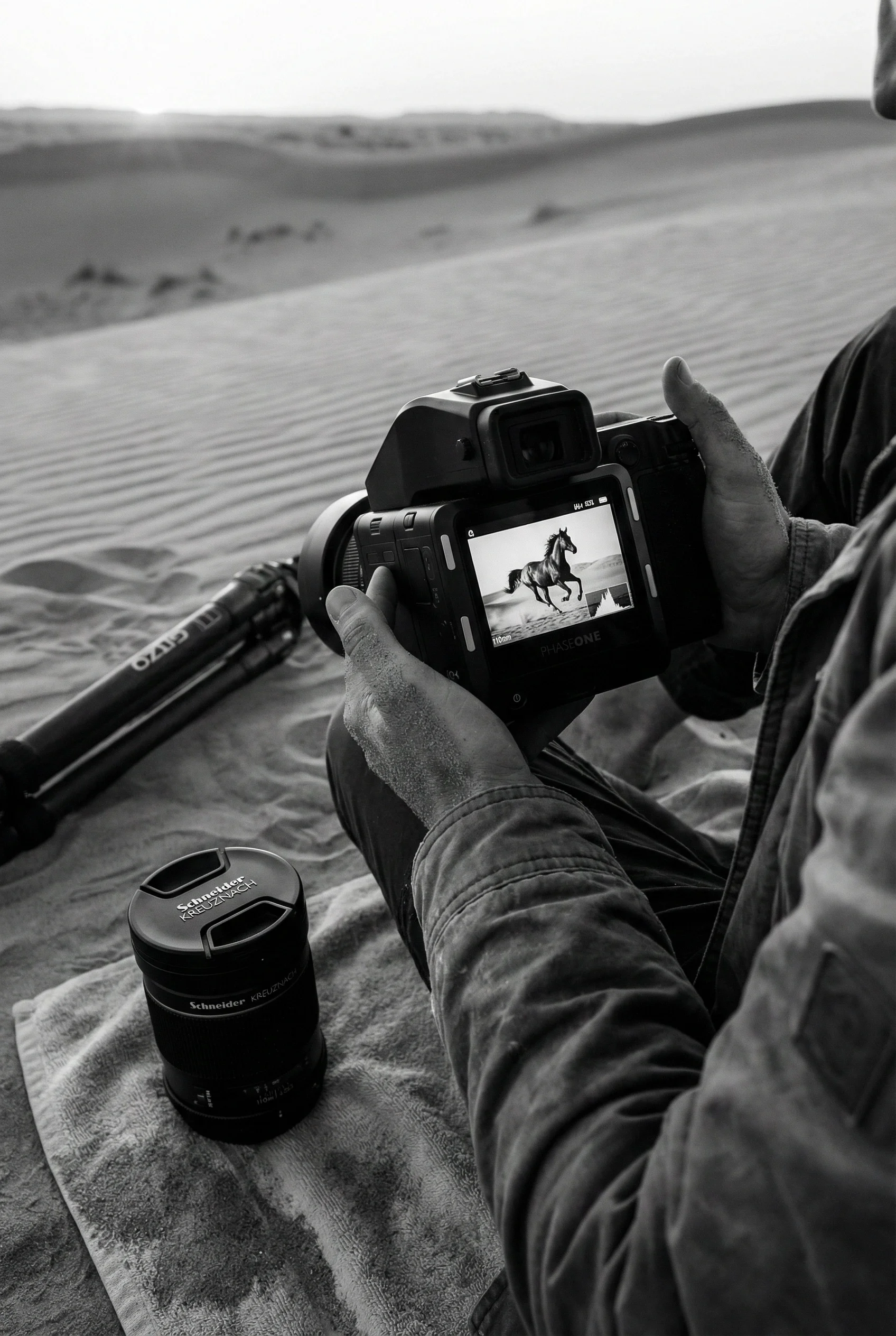
For a photographer working in black and white — as I do for the majority of my fine art work — these curved volumes are everything. Black-and-white photography strips away colour and relies entirely on the interplay of light, shadow, and tonal transition. A flat surface is uninteresting. A sharp edge creates contrast but not depth. What creates depth — what creates the illusion that you could reach into the print and touch the animal — is a continuous, curving surface that rolls through every shade of grey from highlight to deep shadow without a single hard break. That is the Andalusian's body. That is why, when I position my Phase One system and wait for the light to sculpt the horse in three dimensions, there is no breed on earth that rewards patience the way a PRE does.
The Andalusian does not merely carry its rider. It transforms its rider. That is the power of a horse bred not for speed, but for majesty.
The Grey Paradox
Approximately eighty percent of registered Andalusians are grey — a coat colour that, in equine genetics, is not a colour at all but a progressive depigmentation. A grey Andalusian is typically born dark, almost black, and lightens over years into silver, dapple, and eventually a luminous white. This process is itself a kind of artistry: the horse's appearance transforms across its lifetime, each year offering a different palette of tonal possibility.
For the monochrome photographer, a grey Andalusian is both paradise and paradox. Paradise because the coat offers the full tonal spectrum — from near-black in the shadowed folds of the neck to pure white on the sunlit planes of the shoulder — within a single animal. Paradox because that very tonal range demands extraordinary precision. In a 16-bit capture from my Phase One IQ4, I am recording thousands of discrete grey values across the surface of the horse's body. If the exposure is fractionally wrong — even a third of a stop — those subtle distinctions between silver and pearl, between dapple and shadow, collapse. The sculpture becomes flat. The living quality disappears.
This is why I spend as much time reading the light on an Andalusian's coat as I do composing the frame. The coat is the frame. It is the medium through which light expresses the horse's form, and to misread it is to misrepresent the animal entirely.
Movement as Language
The Andalusian does not move like other horses. Where a Thoroughbred gallops — long, ground-covering strides designed for speed — the Andalusian performs. Its trot is elevated, cadenced, with a moment of suspension at the top of each stride where all four feet leave the ground and the horse hangs, briefly, in the air. Its canter is collected, uphill, with the hindquarters driving beneath the body like the engine of a locomotive. Even at the walk, the PRE carries itself with a deliberate, measured quality that communicates not lethargy but control — immense power held in reserve.
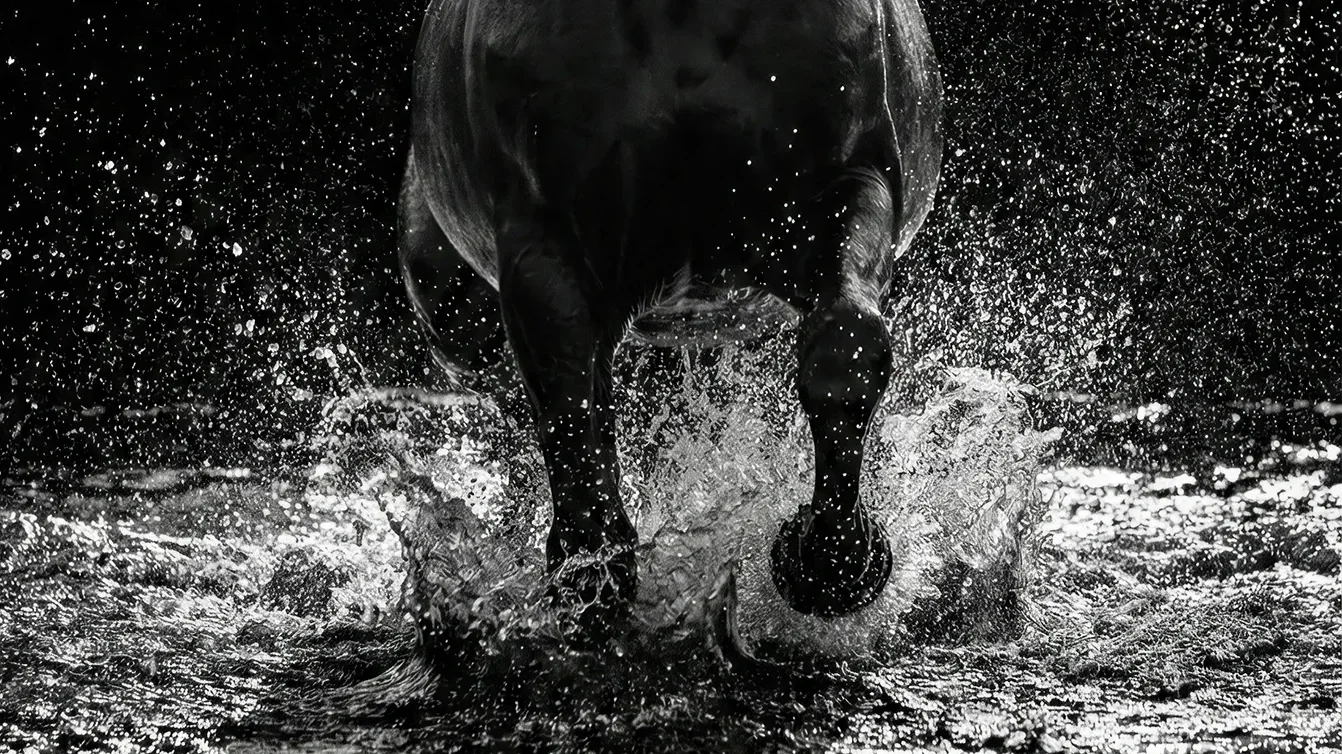
For the photographer, this movement is a gift. The moment of suspension in the trot — that instant when the animal is airborne and every muscle is engaged — produces images of extraordinary dramatic tension. The horse appears to defy gravity. Time compresses into a fraction of a second, and within that fraction, the entire history of the breed is visible: the centuries of selection for elevation, for collection, for that specifically Iberian quality of making power look effortless.
I have learned, over many sessions with Andalusians, to anticipate this moment rather than chase it. The Phase One IQ4 is not a sports camera. Its 150-megapixel sensor demands a considered approach — the shutter speed must be high enough to freeze the motion without losing the luminous quality that slow, deliberate exposures deliver. There is a narrow window, typically between 1/1000th and 1/2000th of a second, where the motion is sharp but the light is still rich. Finding that window, for each horse in each condition, is the technical challenge. The creative challenge is simpler and more profound: be there when it happens.
The coat is the medium through which light expresses the horse's form. To misread it is to misrepresent the animal entirely.
Why the PRE Endures
In an equine world increasingly shaped by sport — by the demands of dressage scoring, showjumping height, and racing speed — the Andalusian remains defiantly itself. Its breeding standards have not been diluted to chase competition results. Its conformation has not been stretched or narrowed to optimise for a single discipline. The breed registry, maintained by ANCCE (the National Association of Pura Raza Española Breeders) with a rigour that would satisfy any museum curator, insists on the preservation of the breed's historical type. An Andalusian born today in Jerez would be recognisable to a Carthusian monk of the sixteenth century. That continuity is extraordinary, and it is what makes the breed a genuinely living artefact.
For collectors of fine art, this continuity has a particular resonance. When you acquire a photograph of an Andalusian stallion — rendered in the full tonal authority of 150-megapixel black-and-white, printed on archival cotton rag with a permanence exceeding two centuries — you are not merely acquiring an image of a horse. You are acquiring a document of a cultural tradition that has survived the fall of empires, the mechanisation of warfare, and the transformation of agriculture. The horse in the photograph carries that history in every curve of its body. The photograph preserves it.
This is, ultimately, what I mean when I describe the Andalusian as living art. Art is not decoration. Art is the preservation of something essential about what it means to be human — our capacity to recognise beauty, to cultivate it over generations, to insist that certain things matter even when they serve no practical purpose. The Carthusian monks who shaped the breed understood this. The painters who devoted their greatest canvases to it understood this. And when I stand in the field at dawn with my camera, waiting for the light and the horse to meet in a single unrepeatable instant, I understand it too.
The shutter fires. The moment is held. And the Andalusian — Spain's living art — endures.